
Industry · Energy and utilities
Energy and utilities data from public sources
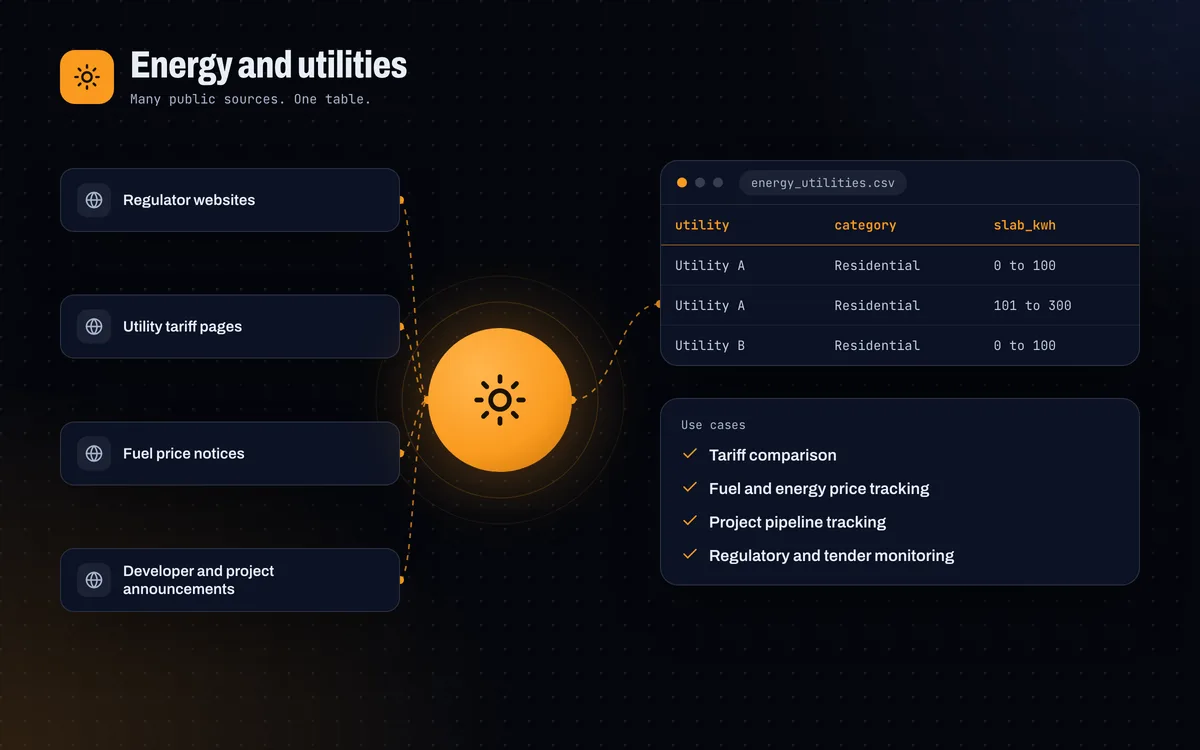
Energy companies, utilities and analysts use public web data to follow tariffs, prices, projects and regulation. We collect published tariffs and fuel prices, renewable project announcements, energy tenders and regulator notices, and deliver them as a structured feed.
Prefer email? Write to [email protected]. We reply within one working day.
Why tracking this market by hand fails
Tariff orders, price notices and project news are published by many regulators, utilities and developers, mostly as PDFs and notice pages. Changes are easy to miss and slow to compile.
Public sources we collect from
- Regulator websites
- Utility tariff pages
- Fuel price notices
- Developer and project announcements
- Public procurement portals
We collect publicly visible, non-personal data and do not bypass logins.
Energy and utilities use cases for web data
How energy and utilities teams use scraped public data, and the fields that feed each use case.
- 01
Tariff comparison
Compare published tariffs by utility, category and slab.
- utility
- category
- slab
- rate
- 02
Fuel and energy price tracking
Record published fuel and energy prices by city and date.
- product
- city
- price
- date
- 03
Project pipeline tracking
Follow announced solar, wind and storage projects and capacities.
- developer
- technology
- capacity
- location
- 04
Regulatory and tender monitoring
Receive new orders, consultations and tenders as they are published.
- authority
- document
- published at
How web data helps the business
The value is not the rows. It is the decisions your team can make with current, complete numbers.
Faster analysis
Analysts work from structured tariffs instead of PDFs.
Earlier opportunities
Tenders and project announcements arrive the day they are published.
Regulatory awareness
Orders and consultations never slip past the team.
A sample of the output
Every delivery uses one schema across all sources, with a source URL and collection timestamp on each row.
| utility | category | slab_kwh | rate | effective_from |
|---|---|---|---|---|
| Utility A | Residential | 0 to 100 | 3.45 | 2026-04-01 |
| Utility A | Residential | 101 to 300 | 6.20 | 2026-04-01 |
| Utility B | Residential | 0 to 100 | 3.10 | 2026-04-01 |
Illustrative layout only. Real samples use your sites and fields.
Services for energy and utilities
Start with one, combine several. Each is built, run and maintained by us.
-

-

-

How it works
You see real data from your own sources before you commit to anything recurring.
- 01
Scope
You send the sites, fields, volume and schedule. We confirm what is practical and how it should be delivered.
- 02
Sample
We deliver a small sample or a paid pilot so you can check coverage and quality.
- 03
Production
We run the feed on schedule, monitor every source and fix scrapers when sites change.
Questions buyers ask
Not covered here? Ask in the quote form and we will answer with your scope.
Can you parse tariff orders in PDF?
Yes, where they are public. We extract the agreed tables into rows.
How often are notices collected?
Daily is typical for regulator and tender pages.
Do you collect customer billing data?
No. We collect public tariffs, prices and notices only.
Other industries
See all industries or browse every use case.


Talk to us directly
[email protected]Tell us about your energy and utilities data needs. A person on our team reads every message.

Send us the sites tonight. Data by morning.
Tell us which websites and fields you need. We confirm what is practical, how it should be delivered and what it costs.
- Goes straight to [email protected]
- Reply within one working day
- A sample or pilot before any recurring plan
- NDA available before you share details
Request received.
Thanks. It is with our team at [email protected], and we reply within one working day.