

Industry · Insurance
Web data for insurers, brokers and insurtech teams
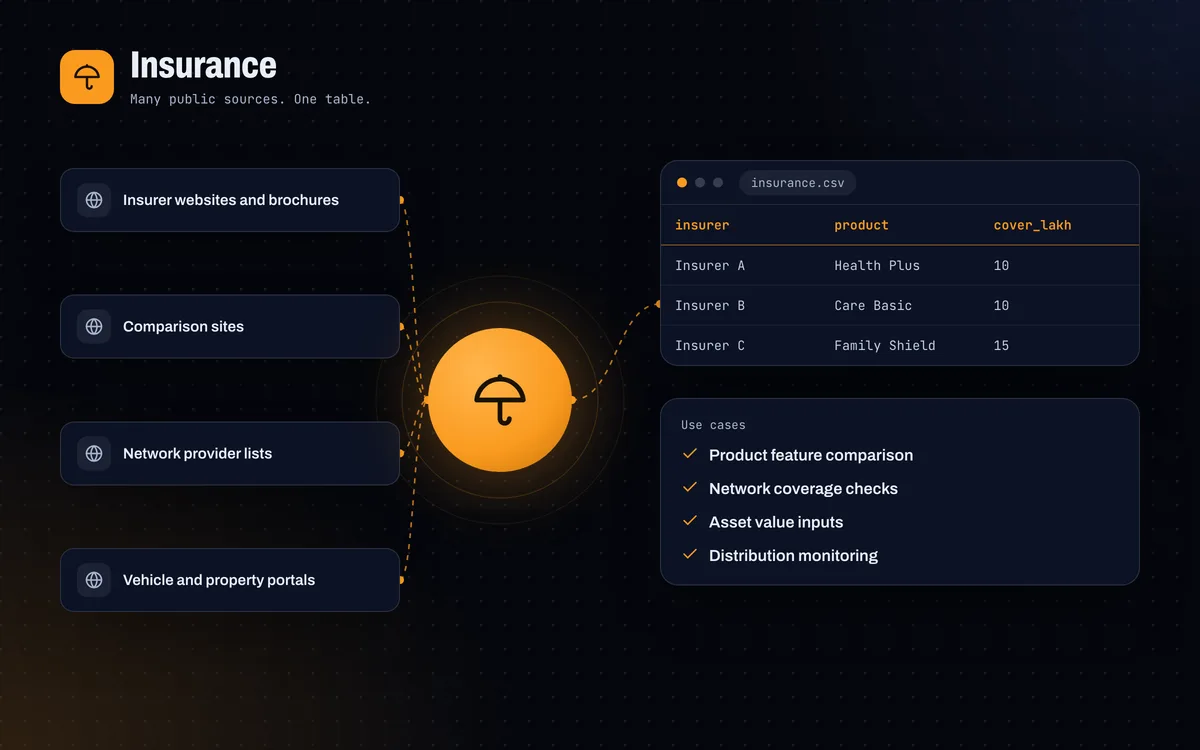
Insurers, brokers and insurtech teams use public web data to compare products, check networks and feed risk models. We collect public policy features, published premium examples, network hospital and garage lists, and asset values such as vehicle and property prices, and deliver them as structured datasets.
Prefer email? Write to [email protected]. We reply within one working day.

Why tracking this market by hand fails
Product details sit in brochures and comparison pages that change without notice. Network lists are long and updated often. Asset values for underwriting come from listings spread across many sites.
Public sources we collect from
- Insurer websites and brochures
- Comparison sites
- Network provider lists
- Vehicle and property portals
We collect publicly visible, non-personal data and do not bypass logins.
Insurance use cases for web data
How insurance teams use scraped public data, and the fields that feed each use case.
- 01
Product feature comparison
Compare cover, exclusions, waiting periods and add-ons across insurers.
- product
- cover
- exclusions
- add-ons
- 02
Network coverage checks
Map network hospitals or garages by city against competitors.
- provider name
- city
- network
- 03
Asset value inputs
Use current vehicle and property listing prices as inputs to valuation models.
- model
- year
- price
- locality
- 04
Distribution monitoring
See how aggregators and partners present your products.
- site
- rank
- displayed premium
How web data helps the business
The value is not the rows. It is the decisions your team can make with current, complete numbers.
Sharper products
Product teams see exactly where competitors offer more or less.
Stronger networks
Coverage gaps by city are clear and actionable.
Better risk inputs
Current asset values improve pricing accuracy.
A sample of the output
Every delivery uses one schema across all sources, with a source URL and collection timestamp on each row.
| insurer | product | cover_lakh | waiting_period | network_size |
|---|---|---|---|---|
| Insurer A | Health Plus | 10 | 2 years | 9,800 |
| Insurer B | Care Basic | 10 | 3 years | 7,200 |
| Insurer C | Family Shield | 15 | 2 years | 11,400 |
Illustrative layout only. Real samples use your sites and fields.
Services for insurance
Start with one, combine several. Each is built, run and maintained by us.
-

-

-

-

How it works
You see real data from your own sources before you commit to anything recurring.
- 01
Scope
You send the sites, fields, volume and schedule. We confirm what is practical and how it should be delivered.
- 02
Sample
We deliver a small sample or a paid pilot so you can check coverage and quality.
- 03
Production
We run the feed on schedule, monitor every source and fix scrapers when sites change.
Questions buyers ask
Not covered here? Ask in the quote form and we will answer with your scope.
Do you collect personal or policyholder data?
No. We collect public product, provider and asset information only.
Can you extract data from PDF brochures?
Yes, where the PDFs are public. We extract the agreed fields into structured records.
Can you get premium quotes?
We collect premium examples shown publicly. We do not submit personal details to quote forms.
Other industries
See all industries or browse every use case.



Talk to us directly
[email protected]Tell us about your insurance data needs. A person on our team reads every message.

Send us the sites tonight. Data by morning.
Tell us which websites and fields you need. We confirm what is practical, how it should be delivered and what it costs.
- Goes straight to [email protected]
- Reply within one working day
- A sample or pilot before any recurring plan
- NDA available before you share details
Request received.
Thanks. It is with our team at [email protected], and we reply within one working day.